
- Home
- Events
Events
 C. S. Lewis – Received, Reflected, Reinvented
The Seventh C. S. Lewis and Kindred Spirits Conference at Alexandru Ioan Cuza University of Iași, Romania
19 - 22 November 2025
❗? More info on: https://iasi.cslks.ro/
Over the past two decades C. S. Lewis has not only persisted as a cultural icon, and his writings as cultural touchstones, but the impact of both his person and his work continues to reach into new mediums and find new expressions in fields he himself could not have imagined. Film, theatre, video games, board games, dance, sculptures, paintings, book illustrations, fanfiction – all join the continual burgeoning of academic papers and theses, biographies, monographs, personal blogs. Since their publication, Lewis’s writings have attracted a wide range of readership and thus an ever-widening range of interpretive responses, such as reading a Narnia novel as basic religious allegory, medieval cosmology, or covert criticism of communism. The process goes both ways, for there is a consistent acknowledgment that these works can, in turn, change perceptions, perhaps even entire worldviews. Of particular interest is how his works – and those of the Inklings in general – have been received, reflected or re-invented through different cultural lenses, societies, languages, and the varying resulting impacts on readers; the variances in apprehension and (re)interpretation in literary criticism and literary history.
 Celebrating 100 Years of English and American Studies in Iasi
International conference, 8-9 May 2025, Iasi
Our contemporary world at large has undergone dramatic shifts of paradigms in the last 80 years or so. Between 1945 and 1960, most of the new states in Asia and Africa achieved at least an autonomy if not complete independence from their European colonial rulers. This situation generated a need for political and cultural (self)identification and self-determination. Decolonisation reshaped the world. In its wake, Asian, African, and Western intellectuals reshaped the cultural paradigm: Fanon, the theorists of the so-called “Subaltern Studies”, Michel Foucault’s analysis of the relation between power and knowledge, Edward Said’s groundbreaking Orientalism (1978) shook the plinth and the whole scaffolding of entrenched colonial culture. In Europe, the French upheavals of 1968, with their makeshift barricades and graffiti protests, paved the path for radical movements of restless emancipation. From France, the zest for ceaseless discontent has spread and conquered both sides of the Atlantic. The advancement of technology inspired Julian Huxley, a brother of novelist Aldous Huxley, to envisage in “Transhumanism” (1957) an era of social and cultural change, a future when humanity transcends itself. In the 21st century, Huxley’s concept of transhumanism coexists with Posthumanism and a range of other theories and movements in what looks like a cacophony of narratives and discourses.
30-31 May 2019, Iasi - Romania
 Oral tradition or oral lore is a form of communication wherein the set of knowledge, art, and ideas which define a given culture is received, preserved and transmitted orally from one generation to the next. Once recorded in writing, a culture becomes visible, its values are expressed clearly, and those records will endure. It is not only visibility and recorded expression that it gains but also vitality and a virtually universal dimension.
We invite participants in the conference From Runes to the New Media and Digital Books to look at how writing in English shaped a language which has become the world’s most used, the lingua franca of our contemporary world. From the earliest indigenous writing found in England, written on the ankle bone of a roe deer, from the Undley bracteate (a gold medalion), which is the earliest example of Old English found so far, from the dramatic increase in the amount of writing in the Middle English period, through the advent of printing to the development of the World Wide Web and the Internet, the history of the English language is the story of its written texts. As Dominic Wyse argues in How Writing Works: From the Invention of the Alphabet to the Rise of Social Media, "New forms of social media still rely heavily on the alphabetic language of English. And new developments such as emoticons and images have been reunited with written language perhaps as an echo of the hieroglyphic past. At the same time the global spread of language, and particularly the English language, as a result of the internet, including in juxtaposition with still and moving images, music and sound, is on a quite extraordinary scale. The extent to which English establishes itself as a digital lingua franca remains an open question” (88).
- Hits: 3465
Second Call for Papers: Interdisciplinary Conference "C.S. Lewis: Of This and Other Worlds"
 The 5th International Interdisciplinary Conference in Iasi, Romania devoted to the life and work of C. S. Lewis:
Of This and Other Worlds
Start date - end date:19-21st November 2020
Registration deadline: 1st November 2020
Early bird deadline: 15 September 2020
The fifth C. S. Lewis conference focuses on C. S. Lewis and his literary and academic kin as creators of worlds. His entire work testifies to his fascination with alternative universes, from his scholarly exploration of Medieval literature, with its haunting myths and arcane symbolism, through his fiction, to his apologetics, where Christianity is seen as a parallel kingdom seeking to be reinstated in “an enemy-occupied territory”. From pain to love, through faith and imagination, he opened a spectrum of realities inviting exploration and reflection. The collection of essays by Lewis alluded to in the title of this year’s conference spans both this and other worlds: “this” realm, which we inhabit, is the necessary, unavoidable starting point for any explorers, conquerors, pilgrims, even refugees into the “others”.
22-23 November 2018
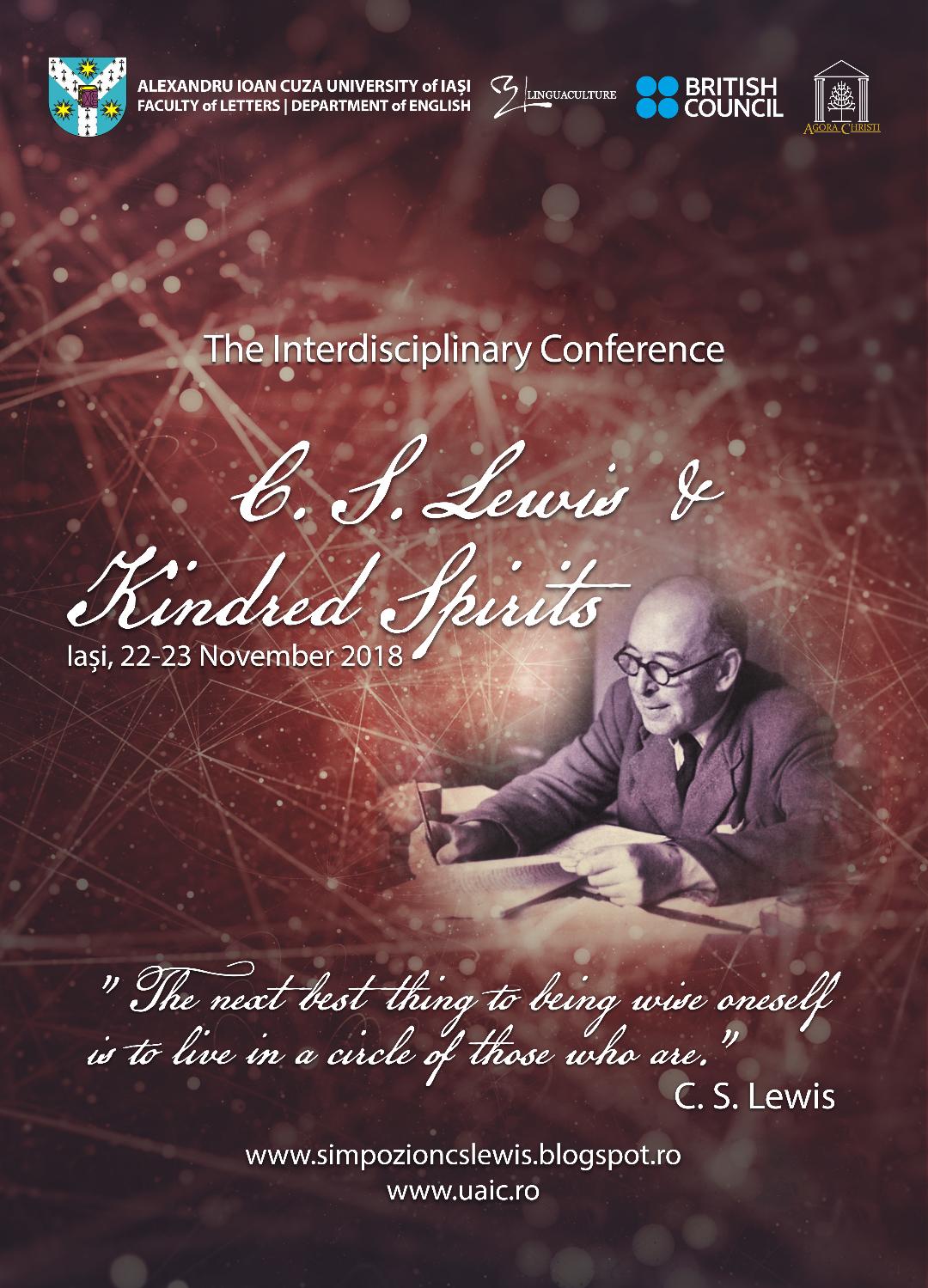 The Fourth Interdisciplinary Conference devoted to the life and work of C. S. Lewis: C. S. Lewis and Kindred Spirits, Iasi, 22-23 November 2018, continues the series of events devoted to the celebrated Oxonian writer and scholar and is open to both specialists and lay people who are interested in, and fascinated by, the Oxford Don’s legacy and influential presence within current culture.
Details on the conference and registration: http://simpozioncslewis.blogspot.com/
IMPORTANT DEADLINES
October 20th early bird conference registration
November 15th full conference registration
October 20th early bird conference registration
November 15th full conference registration
November 15th registration for conference dinner and/or trip to Bukovina
November 20th final registration for attendants
November 20th final registration for attendants
Contact persons:
Professor Rodica Albu: This email address is being protected from spambots. You need JavaScript enabled to view it.
Dr. Daniela Vasiliu:This email address is being protected from spambots. You need JavaScript enabled to view it.
Dr. Teodora Ghivirigă: This email address is being protected from spambots. You need JavaScript enabled to view it.